Simon Willison hides agent-written PR descriptions behind a details tag
Simon Willison says he puts a short human-written opener atop AI-generated pull requests and folds the agent's full description into a GitHub-supported details/summary block, labelled with the model name.
If you use coding agents to open PRs, this is a no-tooling way to keep reviewers reading. A short human opener plus a collapsed agent write-up works in any GitHub description or comment.
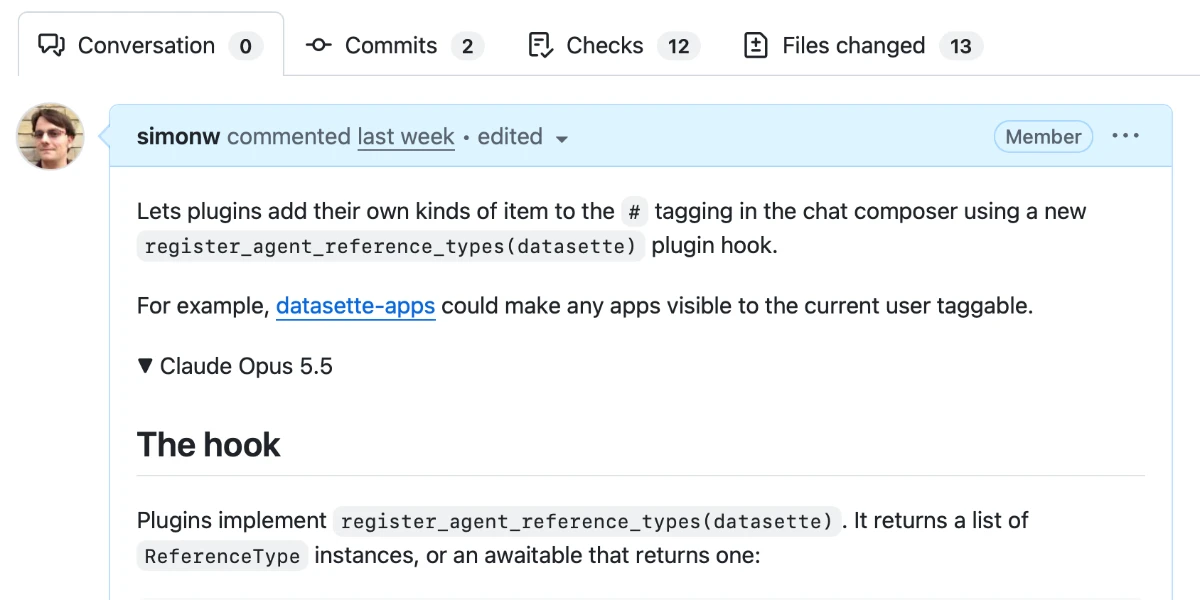
Developer Simon Willison described a habit for AI-generated pull requests in a post on his weblog on 9 November 2026. He keeps a short, human-chosen opening paragraph visible. He then collapses the agent's long description inside an HTML details/summary element.
What happened
Willison says most changes to his projects now arrive as PRs opened by Claude Code or Codex. He treats the PR as his unit of work. Agents write thorough descriptions, he says, but the length puts readers off, including him.
His fix is small. The opener explains what the PR is for, in the fewest words that get a reader up to speed. Sometimes it includes a screenshot. The full agent essay sits below it, collapsed. In his post, he writes that the opener reflects his own judgement of what deserves a reader's time.
Key details
- GitHub Markdown supports the details/summary elements. They show a collapsed heading with an expansion arrow.
- Willison uses the model name, and often the effort level, as the summary text. His example is "Claude Opus 5.5 Medium".
- The opener is sometimes written by him. Sometimes he pulls it out of the agent's own text.
- He cites five examples: datasette PRs #3052, #3043 and #3042, datasette-agent PR #51, and llm PR #1838.
- Some openers include screenshots. The llm PR opener is followed by copied
--helpoutput. - He gives a memory aid for the tag order: say "details-summary", which is two syllables then three.
- He wishes GitHub's Markdown editor had a button for this.
Try it
<details>
<summary>Claude Opus 5.5</summary>

<h2>The hook</h2>

Full agent-written description goes here.

</details>
Why it matters
Agent-written descriptions are accurate, Willison says, but they read like slop and are hard to skim. A short human opener tells a reviewer whether the PR needs attention. Labelling the collapsed section with the model name also makes clear which part came from an agent.
This is one developer's workflow, not a GitHub feature announcement or a study of reviewer behaviour.
FAQ
Does GitHub support details and summary tags in PR descriptions? Yes, according to Willison. He says you can paste the tags into an issue comment or PR description, and GitHub shows the summary with an expansion arrow.
What goes in the summary line? Willison uses the model name, and often the effort level, such as "Claude Opus 5.5 Medium". That makes it clear the hidden text is agent-written.
Which tag comes first? The details element wraps everything, and the summary sits inside it as the clickable line. Willison suggests saying "details-summary" to remember the order.
Checked claims
| Claim | Status | Evidence |
|---|---|---|
| Willison says most of his project changes now arrive as PRs opened by Claude Code or Codex. | confirmed | Most of the changes I make to my projects these days come in the form of PRs opened for me by Claude Code or Codex. |
| He says agent-written PR descriptions are accurate and comprehensive. | confirmed | An agent-written PR description is accurate and comprehensive. |
| GitHub renders details/summary tags in PR descriptions and comments as a collapsed block with an expansion arrow. | confirmed | You can drop those tags directly into an issue comment or PR description and GitHub will hide the details and display just the summary plus an expansion arrow. |
| He labels the collapsed section with the model name and often the effort level. | confirmed | I use the model name and often the effort level as that summary, to make it abundantly clear what is going on |
| He wishes GitHub's Markdown editor had a button for the tags. | confirmed | I still wish GitHub would add a button to their Markdown editor for this |
Question for readersHow do you keep agent-written PR descriptions readable for your reviewers?
Discussion · 0
No comments yet. Start the discussion.
Sign in to join the discussion.